



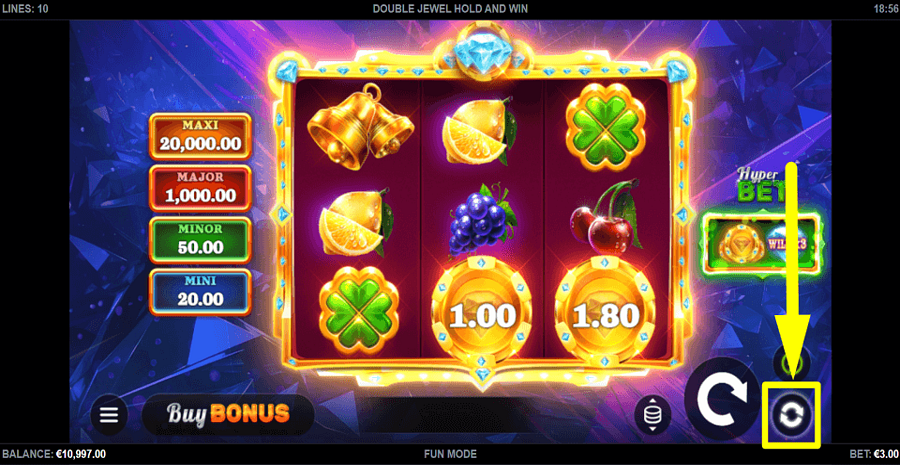
Hold and Win Games is a slot mechanic in which special coin symbols land on the reels and remain locked in place while the remaining positions respin. Each new coin resets a limited number of respins, and any coin that lands can carry a cash value or a multiplier. When the respin counter reaches zero, the total value of all locked coins is paid out. This structure appears in many different titles, yet the core loop remains the same across providers.
How the Hold and Win Mechanic Functions
The standard game runs on a typical reel set, commonly five reels with three or four rows. Regular symbols make up line wins per the paytable. Special coin symbols appear at random; once three or more appear, the Hold and Win feature activates. The triggering coins lock, the other reels disappear, and the grid becomes a holding area with a set number of respins indicated above the reels.
During the feature, only blank spaces and new coins are possible. Each fresh coin stays in its position and resets the respin counter to its original value, usually three. Coins might have set cash amounts, progressive jackpot labels, or multiplier values that increase the total accumulated during the round. The feature ends when either the respin counter reaches zero or every position fills with coins.
Certain versions add a secondary counter that counts consecutive coin landings. When this counter reaches a preset threshold, an extra respin is awarded even if the main counter already reached zero. The mechanic promotes sustained activity and can lengthen rounds that would otherwise finish early.
Reels and Lines Payout Lines and Ways to Win
Most implementations employ a 5×3 or 5×4 layout. The 5×3 layout usually includes 10, Hold and Win site, 20 or 25 fixed payout lines, while the 5×4 setup often transitions to a ways-to-win engine that evaluates 1,024 outcomes. Payout Lines run left to right exclusively, and three or more matching images on consecutive reels produce a payment. Scatter symbols bypass payout lines and count anywhere on the layout.
Some suppliers add extra positions during the Hold and Win round, extending the board to six or seven rows. The additional positions boost the maximum number of coins that can be accumulated and therefore boost the limit of the mechanic. Players should check the information panel to confirm whether the board size shifts when the bonus starts.
Board expansion can also bring new token positions that contain higher fixed worths. A sixth row might include only premium coins valued at at least ten times the triggering stake, while a seventh line may include a single slot reserved for the Grand jackpot icon. These structural modifications directly influence the expected value of the bonus.
Extra Features Inside Hold and Win Rounds
Bonus Spins Combined with Coin Respins
Numerous titles combine the Hold and Win feature with a conventional free spins mode. Landing three scatter symbols awards a designated number of free spins, and any coin that shows up during those spins can still trigger the respin sequence. The two features operate independently, letting the player to gather both line wins from free spins and coin totals from the Hold and Win round within the identical bonus package.
Free spins may also include their own coin multiplier that applies only to values collected during the Hold and Win segment. If a player triggers five free spins and gets a ×2 coin multiplier, every cash coin obtained in the subsequent respin round is multiplied by two before being summed to the total. This layered multiplier structure raises the mathematical ceiling without modifying the base coin values.
Special and Multiplier Coins
Wild coins replace for regular symbols in the base game and also stay put during the respin round. Multiplier coins hold values such as ×2 or ×3; when more than one multiplier appears, their values combine together before being used to the final coin total. These coins occur less frequently than standard cash coins, so their presence markedly raises the round’s payout potential.
Wild symbols can appear in either the base game and the Hold and Win round, however their behaviour is different between the two phases. In the base game they complete line wins, while in the feature they fill a cell and remain locked until the round ends. Because they occupy space without adding cash value, their presence reduces the number of positions available for high-value coins.
Prize Levels and Collection Meters
Many Hold and Win games include four jackpot tiers: Mini, Minor, Major and Grand. Each tier is awarded when a specific pattern of special jackpot coins fills the grid or when a labelled coin lands. The Grand jackpot may be fixed or progressive, depending on the title. A meter displayed above the reels shows the current value of each level, updating after every coin collected.
Collection meters sometimes reset after each feature round and sometimes carry over between sessions. A persistent meter records every jackpot coin collected across multiple rounds, advancing the player toward a guaranteed prize once a hidden threshold is reached. Persistent meters are usually displayed in the lobby rather than inside the game window.
Detailed Guide to Launching a Session
Initially, open the game and review the paytable and rules screens to determine RTP, volatility and feature triggers. Select a bet level that matches the session budget, keeping in mind that higher stakes increase the absolute value of coin payouts but do not alter the game’s mathematical return. Rotate the reels and look for the minimum number of coins required to activate the Hold and Win round.
Once the feature activates, refrain from pressing the spin button multiple times; each respin takes place automatically. Watch the respin counter and take note of any special coins that land. When the round finishes, the game returns to the base reels and any accumulated line wins are added to the coin total. Redo the process until the session budget is used up or a predetermined win goal is reached.
Session tracking tools available on many platforms track the number of Hold and Win rounds triggered and the average coin total per round. Analyzing these statistics after fifty spins gives a clearer picture of whether the current stake level aligns with the player’s target return frequency.
Stake Range, Maximum Exposure and Jackpot Types
Stake sizes commonly start at 0.10 per spin and go up to 100.00, though individual games may raise the upper limit to several hundred credits. The max exposure, shown as a multiple of the overall stake, ranges from 5,000× to 20,000× in fixed jackpot versions. Progressive jackpot versions show a theoretical limit that depends on player volume and seed amounts, so the number visible on the jackpot meter is the value that would be given at the time of winning.
Players should note that some sites establish their own min and max bets regardless of the game’s default range. Reviewing the bet selector inside the game window confirms the real limits offered at that site. The same review reveals whether the Grand jackpot is restricted or pooled across multiple sites.
Stake limits also affect the speed at which progressive jackpots increase. Higher minimum bets accelerate meter growth because a greater portion of each stake is channeled to the fund. Conversely, low-stake environments produce reduced growth, which can lengthen the time between noticeable jumps in the shown Grand amount.
Typical RTP Spreads and Volatility Profiles
Hold and Win releases display RTP percentages spanning 94 percent and 96.5 percent. The lower end of the spectrum appears in games that assign more of the payback to the jackpot fund, while higher figures are found in releases that pay smaller coin values more frequently. Players can find the exact RTP in the game’s information screen before setting a bet.
Volatility is moderate to elevated. The base game produces modest line wins at a consistent pace, but the biggest outcomes are concentrated in the Hold and Win round. Because the feature activates infrequently, sessions can include extended sequences of small results then occasional large coin payouts. This pattern fits players who accept longer dry spells in exchange for the chance of a substantial single-spin return.
Volatility also differs within the same title depending on the chosen stake level. At the smallest bet, the allocation of coin values stays unchanged, yet the absolute size of each payout shrinks. At the maximum stake, the same coin values adjust proportionally, increasing both the ceiling and the apparent swing of the session.
Typical Errors and How to Avoid Them
One frequent error is ignoring the gap between set and progressive jackpots. A set Grand payout gives the same amount irrespective of stake size, while a progressive payout increases with total bets placed across the network. Players chasing the highest reward should confirm which jackpot type is active before increasing their stake.
Another issue arises when autoplay is turned on without establishing a loss limit. Because Hold and Win occurrences are uncommon, long autoplay sessions can deplete a bankroll before the feature triggers. Establishing both a loss limit and a single-win limit inside the autoplay menu avoids unintended overspending and enables the player to review results after each feature round.
Some players also fail to confirm whether the game employs a local or network-wide random number generator. Local RNGs create independent outcomes for each venue, while network RNGs sync outcomes across multiple operators. Grasping this difference aids illuminate why two players at different sites may see different trigger intervals even when using the same title.